About this blog

This Blog is named after an ancient gnoseological riddle which hints hidden, disseminated, omnipresent wisdom.
I invite you to search, listen and observe with me for "the word of tree, whisper of stone, and humming together of the abyss and stars."

2022/02/24

God against censorship

American white evangelicals have been recently up in arms, yelling at teachers and being rude at school board meetings, attempting to ban books from classrooms and school libraries, demanding gagging orders forbidding teachers to talk about race or LGBT issues. Dozens of innocent books have been banned.
     And it did not stop at school boards! There are now more than 150 legislative bills introduced in 38 states of our union that attempt to censor what teachers are allowed to say or teach in their classrooms.
      It is quite upsetting but also mildly amusing coming form specifically those groups. How come these racist fundamentalists don’t know their bibles? Or are they just hypocrites and their “Christianity” is just a cloak for bigotry and racism? In the Bible there is a story about censorship with a lesson they certainly should hear and learn.
      In Jeremiah 36 we hear how scribe Baruch wrote down Jeremiah’s prophecy King Jehoiakim, probably unable to read, asked it to be read to him, and as they were reading it, the king would use his knife and cut it and burn it piece by piece until he burned the entire scroll. King thought, that was the end of it.
      But God commanded Jeremiah: Get another scroll and write in it all the words that were in the original burned scroll. And so Jeremiah took another scroll and gave it to his scribe, and he dictated and Baruch recorded all that has been burned. Only this time, it has been substantially expanded!
     So here you have it! The Bible itself is teaching that burning books and censorship are impotent and futile. And that is something you might not know about the bible. And that is also good news for all freedom loving people everywhere. Freedom loving, free consciousness loving, free spirit loving, freedom of speech loving. And for us in our current context there is reassurance to fight back censorship. Any racist attempts to censor black history will NOT succeed.

And if you read this far: there is another interesting biblical exegetical aspect and theological insight.
     The story about the burning of a prophetic scroll from Jeremiah 36 has a close antipodal parallel in the 2 Kings 22 in a story about the discovery of the Torah scroll in the temple supposedly at the time of king Josiah.
     Modern scholarship suspects that both these stories are in fact much later literary fictions. They required certain conceptual and mentality preconditions among the authors as their audience. It could have been written and made sense to the readers only after they encountered and became familiar with the Babylonian legal tradition and especially after they experienced the Persian administration relaying on written documents.
     The Persian setting - after the time of Ezra, Nehemiah - is to me the terminus post quem and possibly a much later moment for creation of these literary fictions. They are two complementary parts of the same biblical sermon teaching something similar to this - When encountering a challenging, uncomfortable writing – we all can chose – do we want to be like Josiah embracing the text and learning from it or do we want to be like Jehoiakim burning it?
     Recognizing this connection and dating this dual sermon to the Persian period or even later makes this argument only stronger and more plausible. This late Persian, and possibly even Hellenistic homily about two approaches to the challenging message is another aspect you might not know about the Bible. It might be a literary fiction but at the same time a powerful encouragement not to burn, ban or censor uncomfortable books but to study them and take them seriously.

2022/01/20

Was Jesus illiterate?

Mapping the US book deserts.
A percentage of homes with at least 100 books.
Interactive map can be found here.

Video version of this blog can be found here on YouTube.
 
Scholars and theologian are all but unanimous that Jesus and his Galilean disciples were almost certainly unable to read or write. But please, note that I did not call them illiterate! That would be a gross misrepresentation of their reality. Modern scholarship calls such people nonliterate.
            There is an important distinction between illiterate and nonliterate. Illiterate are people who had opportunity to learn reading and writing and yet had never done so. Meanwhile nonliterate persons are those who never had the chance to learn these skills because they lived in a society where hardly anyone could read or write. Such a setting is being described as preliterate society.
            In our world and time illiteracy often comes with a stigma, a value judgement about the person’s mental acuity. In the preliterate society inability to read and write was common and did not come with such a stigma.
            Literacy all around the Ancient Mediterranean world was about 5%. And our best estimates of literacy among the Jews living in Palestine (from Judea to Galilee) was hardly any larger. And those literate were members of an elite class, who almost certainly did not live in a Galilean rural hamlet like Nazareth. The setting of Jesus’ movement was indeed an oral,  preliterate society. And Jesus and his disciples’ inability to read did not mean they were stupid.
            On the contrary, anthropologists tell us that nonliteracy gave people some unique and special faculties. Preliterate oral cultures had a phenomenally better narrative memory. From my study of Hawaiian history and culture I am aware of early missionaries in Hawai’i reporting with  astonishment the ability of nonliterate locals to reliably memorize entire biblical books. And that has been reported all over the world.            Mental capacities of nonliteral peoples are not hindered by literacy. Their intellect is not under the spell of the written. They have a different, intuitive, and broader, more holistic, perception of reality.
            In addition and interestingly, to my best knowledge, all the main world religions were born in this twilight zone of literacy, inspired by nonliterate founders, and only later scriptualized - written down. In fact if Jesus and his first Galilean disciples were literate, it would had been a highly irregular and hence suspicious.
            The very fact that Jesus and his first disciples were nonliterate, the fact that there was a period of oral transmission, the fact that the Bible was written only about a generation or two later, all of it is an important factor which we normally do not fully appreciate but which was a contributing reason that we have Christianity and our New Testament Bible.  And that is something you might not know about the Bible.  
 
Join us this Sunday when we will discern and contemplate the only one New Testament story about reading Jesus (Luke 4:16ff). It might be a wishful projection of a highly educated evangelist, but exactly as a projection it still contains a beautiful and powerful message of divine love and respect for everyone, and especially for those left out and forgotten.

2022/01/13

Revolution in Heaven

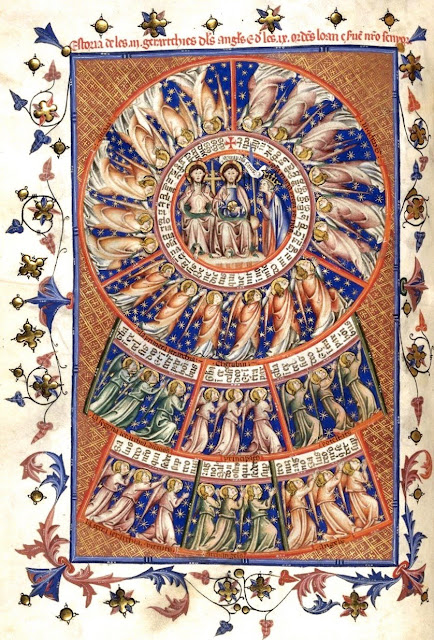
Nine classes of angels in three spheres depicted in a medieval manuscript.

Have you heard about the revolution in heaven? Have you heard how Jesus overthrew the heavenly hierarchy?

     First I need to explain the angelic hierarchy. The ancient polytheistic peoples were familiar with the notion of the divine court. Greeks situated it on Mt. Olympus. North West Semitic people looked up to Mt. Zaphon (modern Jebel Aqra). Of course the Hebrew Bible knew about Zaphon but there are also signs that Mt. Sinai, Mt. Zion or occasionally other mountains might play a similar role.

            A deepening process of monotheisation under the prophets like Isaiah or Jeremiah led to less interest in the divine court. But then, it found its way in again during the late biblical period under the influence of apocalyptic writings such as Ezekiel or Daniel. In this stage, what used to be deities were replaced with throngs and retinues of angels. The angelic hierarchy was imagined and structured according to Hellenistic Royal Courts. Later the rabbis organised angels into no less than 10 classes or ranks. But the Jewish angelic hierarchy stayed rather fluent and even a little chaotic. For instance different cabalistic schools could have one class of angels, for instance Seraphim, in the highest rank as well as lowest rank and anything in between, depending on the author.

            Roman Catholic medieval Scholasticism put angels in better order, probably inspired by needs of the medieval feudal church. Angels were organised in three large spheres and nine different classes. The highest sphere was for angels who were constantly in the presence of the divine and never left. Beneath them was the intermediary sphere of angelic functionaries mediating divine commands to the lower angelic sphere. The lowest angelic sphere was charged with execution of divine orders. Here were patrons of nations and royal houses, here were archangels in the second lowest class. Lower were only regular angels and the lowest of lowest of angels were the personal guardian angels, the blue collar angels, angelic proletarians. 

            Angelic hierarchy thus reflected medieval feudal structures of power but also represented the general human desire for order in the hierarchy of power. Image of heaven in Roman Church reflected medieval feudalism, in the Biblical times it reflected Hellenistic courts, among early Jews and pagans Zaphon, Sion or Olympus were perceived like Bronze Age royal palaces. (In heaven it was as it was on earth. When you think about it, it was the very opposite of one of the petitions of the Lord's Prayer.) 

            And then, Jesus, as was his well-established practice, turned this all upside down in one sentence.  Matthew 18:10 in my loose rendition - Don’t even think to disregard and neglect the powerless, I tell you, their guardian angels have direct access to God. (My loose translation.)

            The lowest, worldly, working angels, that angelic proletariat has direct access to God! That is revolution in heaven. As if Jesus said, Stop projecting your human corrupt power structures to heaven! Rather, change your human structures according to the egalitarian heavenly model which I bring and preach to you. 

            That is what I call the revolution in heaven. The overthrow of imaginary heavenly hierarchy and by the way the utter abrogation of heavenly and earthly feudalism or any other abusive power structures which humankind is so eager to create and recreate.

            The first are last and last are first in heaven! And the first will be last and the last will be first in bright divine future. And you should start living it out now.


And that is something you might not know about the Bible and Jesus’ radical angelology.


Video version of this article can be found on Rutgers Church YouTube


And here it is being explained to children in virtual Children Message

2021/12/30

God and her loom

The Bible is full of surprising images and metaphors when it speaks about God. Take for instance Jesus’ parable of the lost coin. In it God is compared to a housewife sweeping the floor.

     The Hebrew Bible contains similarly surprising metaphors. When, for instance, Job (7:6-8) and prophet Isaiah (38:12) lament the fleeting nature of human life they use a metaphor of weaving. Job is the most evocative comparing human life to a weft, the thread swiftly flying off the shuttle.

            That is a highly surprising image because within the context it implies that God is the weaver. And here you need to understand that throughout the Middle East the spinning and weaving were activities for women. We know it from myths, documents, as well as, artwork. And it is confirmed by the bible itself. Delila is to fasten and weave Samson’s hair in her loom (Jdg 16:13). And part of the Josiah reform, we are told (2Ki 23:7), was that he threw out female weavers from the temple.

            For all the ancient middle eastern people a weaver God takes up a clearly feminine role, female household work. As much as the Hebrew Bible is predominantly patriarchal and God is portrayed as male, there are these surprising depictions of God clearly taking over female gender roles. And that is something you might not know about the Bible.


Join us this first Sunday of the year 2022, we will lift up and expound this image of a divine weaver – far from talking about a loom of gloom, it in reality contains a beautiful, illuminating and hopeful message.


- - - - - - -

And for those who read this far and might be interested in understanding the Bible within the context of the Ancient Near Eastern religion here are a few more words.

            In the mythology from Ugarit (Ball cycle, KTU 1.4.ii), it is the goddess Asherah who is depicted as spinning and dyeing a yarn. And those earlier mentioned female weavers who were thrown out of the temple by Josiah, were allegedly making fabric for the same goddess. 

            It is therefore possible that in the process of monotheisation of the biblical religion, this single Biblical God absorbed some attributes, functions and activities of the goddess Asherah, thus combining gender roles, and becoming biblical version of divine Herm-Aphrodite.

            Earlier we made several short videos and some blog entries linked here:


"Does YHWH Have a Womb?" https://youtu.be/5AYosnwrtz0 "God Our Mother" https://youtu.be/WssQ06JRw24

2021/11/19

Fragrant Christ


It is a sign of biblical literacy, if not basic cultural competence, to know that “Christ” was not Jesus’ second name nor his surname. Children in the Sunday School learn that Christ is from the Greek word χριστὸς and itself is a translation of Hebrew word Messiah מָשִׁיחַ and in both cases the meaning is “The anointed one”. And they also learn that anointing was an Ancient Near Eastern act of promoting persons to some high offices, to priesthood, kingship, occasionally to a role of prophet. Thus sur-name “Christ” is in fact an honorific title. Our modern theology and liturgy tries to highlight this original meaning by using expression "Jesus the Christ".      
    
Nevertheless, the New testament writings and the Early Christianity were fully immersed in the Hellenistic Greek Culture and in it the inaugural anointing was not widely used and known. And thus already from the later parts of the New Testament onward the title Christ lost the meaning of an honorific title and started to function as a second name, it became part of a holy name (nomen sacrum).
   
And this early (biblical) onset of pious ignorance is something you might not know about the New Testament Bible.


I mentioned that the Hebrew word messiah מָשִׁיחַ was an honorific title indicating that the person was inaugurated into some higher-ranking position by the act of anointing - pouring fragrant oil over them. Kings, priests and prophets were called anointed. 

    But the act of religious anointing (root משׁח) was not reserved for people alone. Religiously anointed were also the temple furniture (ark, lampstand, incense table, utensils) even the sanctuary/tabernacle itself. Anointing was a religious ritual consecrating objects or people as holy, setting them apart for special religious functions.

    Anointing was in fact a liturgically enacted metaphor with several interconnected meanings. 

Oils have preservative faculties that slow down rusting or rotting - thus anointing visualized and represented this desire to forestall decay. Before the invention of soap, oils played an important role in personal hygiene (rubbing oils on skin and scraping off dirt) - thus anointing was associated with cleanliness. Oils and ointments especially infused with herbs are used until now in medicine - thus anointing represented this desire to protect the health of the anointed. Oils infused with herbs were also used as perfumes, covering or repelling unpleasant odors. Here you need to understand that in ancient times it was about more than just cosmetics. Demons were believed to reek - thus anointing actualized repelling demons.

    Anointing was associated with preservation, cleanliness, health and repelling of demons, it was in fact apotropaic magic - a high brow religious ritual to set objects or persons apart and to express desire in protecting them from evil influences. 

    And this deep apotropaic function of anointing is something you might not know about the Bible (biblical religion).


And here is a YouTube video of the sermon: Fragrance of Loving Care.

2021/11/04

Mythic Grains

Ugaritic tablet KTU 1.6 with text of part of Baal Cycle.
Among the Ugaritic Mythological texts, there is this interesting part of Baal myth (KTU 1.6.ii.31-37 in my translation and partly reconstructed from parallels).

     Goddess Anat grasped divine Mot,

     with a trashing blades she split him,

     with a fan she winnowed him,

     with fire she parched him,

     with millstones she ground him,

     on the steppe she scattered him,

     in the furrows she sowed him.

     His remains the birds did indeed eat,

     his remnants the sparrows did consume.


     Do you recognize how similar it is to the parable which Jesus said?! The one about the different seeds landing in different soils and about their different destinies.

     Well, I am not suggesting that Jesus copied ancient Canaanite myths, of course he did not. Those myths are twelve hundred years older and were buried in the ruins of the city for centuries.

     But Jesus was certainly drawing from the same treasure of religious metaphors. Those religious metaphors about grain date from great antiquity, from the beginning of farming, thousands of years before the time of Jesus or the time of Ugarit.

            And these mythical metaphors were not limited to Hebrew or Semitic people. It is likely that similar grain metaphors played an important role in the Greek Eleusinian Mysteries. And among the hairs of Celtic religion and culture are present in the ballad John Barleycorn must die (A friend Neil Nash alerted me to this fact.)

            In the New Testament Jesus is not the only one who uses this grain metaphor. Apostle Paul reached out to the same mythic treasure when he tried to explain to the Corinthians (1Cor15) the resurrection. He used the similar metaphor of grain being buried and then rising to new life.

            And thus through Apostle Paul and the parables of Jesus we share this important, meaningful and beautiful connection with the dawn of civilization, the beginning of agriculture, and the oldest shared hopes of transcending our mortality.

            And that is something you might not know about the Bible, about the New Testament metaphors and their deep, meaningful, mythical roots. 


Video version of this blog can be found here.

2021/10/28

Martin Luther and Witches

One of our most watched video clips on YouTube is “Something you might not know about Martin Luther”.  It is provocative (definitely for some) but a truthful take on Luther’s visceral medieval belief in the existence of the Devil. Here is the link to this short video: https://youtu.be/-KPOMmDSPHU
    It became so “popular” because many faithful Protestants (especially Lutherans) became quite uneasy and unhappy about the content and shared their opinions and comments.
    I was born and brought up in one of Europe’s union denominations which was composed of both Lutherans and Calvinists and thus I received a thorough Lutheran upbringing and education. That way I know that true Lutherans do not worship Luther. He certainly was not a saint, he was a father of reformation but also a son of his time and shared many diverse and dangerous prejudices of his time.
    Besides the Devil or Satan, he also staunchly believed in the existence of witches. Luther is on record accusing witches of throwing charms on little children causing them such a sharp pain that they cried themselves to death. (Table talk in February and March 1533).
He also accused them of spoiling milk, eggs, and butter and for these minor infractions he approved the popular opinion that they should be burned (Table talk on 25 August 1538).
    We all know that was not a joke and how destructive this prejudice was costing hundreds and hundreds of innocent lives of those who for many different reasons did not fit within a tightly knit & rigid medieval/early modern society.
    But before we get all smug and finger pointing, accusing or ridiculing bigoted Luther and his superstitious times (or on the other side defending indefeasible!) - let us look where we are in our own world!
    Modern anthropologists (folklorists) find peculiarly close parallels between medieval witch prejudices and our modern anti-vaccine conspiracy theories.
    They share similar levels of prejudice, fear, and irrationality; similar tidbits of facts chained into the most bizarre combinations; similar illogical connections and narratives; and similar dangerous/destructive consequences - costing lives. Costing lives of those ensnared by these superstitions and unfortunately costing innocent lives of people around them. 

And that is something you might not know about ourselves and about our very own and dangerous superstitions and bigotry. 

    And now a word of hope and encouragement - Luther himself insisted he was not saved by his own goodness but by divine grace alone. We do not need to censor him or whitewash him. He certainly was a very conflicted and complex figure and he remains a bridge person from medieval prejudice into a more modern and more rational, enlightened paradigm.
    And exactly in this tension and transition between past and the future Luther can be our inspiration and our hope right where we are, tormented by our own manifold irrational political, medical and social conspiracy theories. 

Join us as we learn from the past to reach out forward for liberation and divine grace.   


And here is a video version of this blog.