About this blog

This Blog is named after an ancient gnoseological riddle which hints hidden, disseminated, omnipresent wisdom.
I invite you to search, listen and observe with me for "the word of tree, whisper of stone, and humming together of the abyss and stars."
Showing posts with label Renewal article. Show all posts

2015/12/08

Refugee Jesus

I love this painting of Adoration of Kings by Jan Brueghel de Oude (the Elder). It marvelously fits with our theme for Advent and Christmas - Refugee Jesus. Just look at the ruined home into which he was born. It looks like a shanty or a home in a favela; a house cobbled together while already coming apart, yet still miraculously holding together...
    And then look at the sea of people, all those different dresses and diverse headgear! Those are truly crowds of people gathered from all corners of the world, at least as they knew it in XVI century Europe. But please, notice, not all people are interested in Jesus. Unlike more traditional nativity and adoration paintings, this one is not built around baby Jesus. This painting is different, more realistic, and I would say, also theologically more correct. Jesus is born into this world, but to a large degree, the world does not care. The World and its cities live as if nothing happened. Just around the corner people go on about their petty busyness and they do not notice a damn thing.
     And yes, then we can observe the rubberneckers and nosy folks who just like sensations or at least something, anything, happening. We also know these people with an attention span of minutes, just like today’s media. Then there are also the opportunists who love to use religion to boost their own image and their agendas. Look at those kings in Brueghel painting (and there are more than the traditional three) - at least some of them are recognizable caricatures. Brueghel clearly mistrusted and disliked royalty and nobility - those with power and always seeking more power.
     And he had an even bigger issue with people bearing arms. Soldiers and lawman ostensibly guard order, and citizen bear arms allegedly for their own protection. As we know from the biblical story, in just few days, many of those arms might be used in mass murder of the innocents of Bethlehem. Just as it happened many times over through the turbulent religious history of Brueghel’s home Flanders in the XVI century.
    Brueghel had clear artistic intuition. Jesus was born to this world. Through his life and especially through history Jesus became surrounded and associated with the sensationalist media and with the opportunists of power but he was and remains, in essence, an incarnation of humanity as God intended. Unfortunately in the alienated and alienating world, it means he was born as a poor vulnerable child in the center of cacophony of the world and away from centers of power. The biblical baby Jesus, transplanted into the early modern Flanders, brings hope to all the lost, forgotten, poor, marginalised, oppressed - and that is the true Good News of Refugee Jesus. Just wonder how and where would Jan paint Jesus today?      

By the way, the development and composition of this painting was developed and kept in the Bueghel family for generations. The tradition of non-idealised Jesus and Mary and caricature kings started with Pieter Brughel de Oude, was taken and further developed by Jan Brueghel de Oude and later copied several times by his sons Jan Brueghel de Jongere (the Younger) and his brother Pieter Brueghel de Jonger. Both “Jongers” copied works by their father and grandfather and sold them under “Oudes” signatures - speaking of early modern forgeries! So, who knows who exactly made this painting, and does it really matter? It was in this Flemish family.

2015/09/10

Welcome here!

This column was written for Rutgers Pictorial Directory. 

The doors of our church are garlanded with prayer flags, many of which we made ourselves. They stand for our commitment to open-minded dialogue with other faith traditions. These prayers express our care and concern for our neighborhood and for our environment. Our open-minded prayer flags welcome you here.
     Above our door are a cross and a large banner with our logo. It shows our commitment to the history and ministry of Rutgers Presbyterian Church (established in 1798). We have a long tradition of keeping our faith contemporary and relevant, living our faith in a healthy tension with modern times. We don’t hide who we are, and we welcome all honest spiritual seekers.
    Above our building flies the rainbow banner because Rutgers has always been a progressive church and for more than a generation we have officially been a More Light church - a church welcoming and affirming people regardless of their sexual orientation. You are welcome here.
     Our doors, our minds, our hearts are opened, You are welcome here! On the following pages you will meet us face to face. Church, after all, is not buildings, not flags, nor banners, but people, the community! Our pictures, our faces, show the loving diversity of our church. Jesus did not discriminate, neither do we - so you are welcome here!

2015/06/18

Spiritual Camping

Camping is more than just staying in a tent. It has a deep cultural dimension. Human culture, especially western industrial society, is driven by the profound fear of insecurity, temporality and transience. We do our best to insulate ourselves from the elements, from the surprises and hazards of nature and thus we build our homes, our cities and our infrastructures to cocoon ourselves.
Our little HubbaHubba tent at 12'000 ft above sea level.
     Camping takes almost all our cultural pride (and if you want, arrogance) away. In a tent we are only a thin fabric away from the elements. In a tent we cannot ignore the fact that we are just a part of the universe. This spring I was reminded of it in a very profound way. We were hiking in Hawaii. The night caught us high on the slopes of Mauna Loa, snow patches were all around us. We pitched our little hiking tent right behind a rock shelter. Even in mountaineering sleeping bags we were just about cozy. The tent groaned and rattled all night under the strong wind, providing us with a tenuous protection and only a short and shallow sleep. And yet it was a most memorable vacation night and also a very powerful spiritual experience. We were just a thin fabric away from pinching cold, buffeting wind, bright night, crisp Milky Way and the world biggest active volcano! 
     Of course you do not need to climb high mountains to experience this spiritual dimension of camping. In any tent, when you lie down to sleep, you can hear every rustle of a leaf on a nearby tree, you can hear a chipmunk scrambling about, and to an untrained ear it often sounds like an elephant. In a tent one can hear even a beetle climbing a stalk of nearby grass, not to mention buzzing, and whistling of those thirsty mosquitoes - thankfully that they are held at bay by the tent! The weather can turn nasty, and we can see from beneath a drumbeat of rain and perhaps hail and feel every gust of the wind. How thankful we are for that hair-thin insulation from the raging elements! 
     Camping is a marvelous experience; it is a perfect reminder that we are part of nature. It is also a gentle reminder and illustration of the insecurities and transiency of our lives. It is indeed a profound spiritual experience and exercise. No wonder it has been a part of our Judeo-Christian religion. Every autumn our Jewish neighbors celebrate the holidays of Sukkoth. During that holiday they are to stay for a week in tents or temporary booths - something quite difficult to accomplish in an urban place like New York City. Yet even in Manhattan it can be done. Around that time, you can notice some strange structures on balconies, rooftops, courtyards and around some synagogues. The holiday of Sukkoth is a vivid reminder of the original simplicity of life and the humble nomadic origins of our faith. Yes, of our faith! Because as Christians we share those same origins. What is alive in Judaism was unfortunately all but neglected and forgotten by the Church. 
     I do not think we should slavishly adopt the celebration of Sukkoth, but consider this summer or any next appropriate time to spend at least one night in tent. Especially for us city-dwellers, it can be a transformative and deeply spiritual experience.

Hiking and camping in Hawaiian snow.

2015/02/28

The Radical Love Songs for Lent and Easter

This Lent and Easter season at Rutgers we are reading the Song of Songs, also known as the Song of Solomon or The Canticles. It is beautiful, sometimes sublime, sometimes almost racy erotic poetry. (If you have never heard of it and are interested, the Song of Songs can be found in Christian Bibles close to the center of the volume, after Psalms, Proverbs, and Ecclesiastes and before Isaiah and Jeremiah.)
    Of course the Song of Songs is not a normal Lent and Easter biblical reading for Christian churches. Traditional conservative Jews and Christians have always had a problem with this book. It was one of the last books to be included in the Hebrew Bible and it happened only after extensive rabbinical discussion. The Ancient Synagogue and Early Church accepted this beautiful book only after they “desexed” it by twisting it with a forceful allegorical interpretation where the groom became God (or Christ for the Christians) and the bride was supposed to represent the people of Israel (or the Church).
    In reaction to this emasculating allegorical interpretation, modern theology went all the way in the opposite direction. Modern approach of the twentieth century used an uninhibited fleshy reading and re-asserted and lifted up its erotic and at times XXX rated content. Most recent scholarship influenced by feminist as well as LGBT theology attempts to balance these older approaches and reach beyond them for some beautiful and powerful insights enriching our love, life and faith.
    In this postmodern interpretation, the Song of Songs presents us with a fresh worldview as seen by Ancient Near Eastern love. This world view might be old but it is also surprisingly timeless - the love perceives world in a gender inclusive and balanced manner as both lovers are given almost equal prominence. This love's worldview is also color (or race) blind or even better, actively attracted by the different and the other. Considering its intimate genre it also draws a surprisingly broad geographic circle. The love's worldview also has an intense interest in nature, in flowers, trees and animals both domestic and wild. Ancient love was clearly informed and interested in what we would now call the environment and ecology and the anti-consumerism movement. Ancient love was also realistic, it was exposed to prejudice, bullying, persecution, violence and abuse by the rich and powerful, and it protested and found the strength and means to fight back and to survive or come back.
    Thus the Song of Songs is beautiful erotic love poetry but also deals with race, gender, geography, environment, and abuse and prejudice from the perspective of the biocentric worldview of love, offering deep insights, transformation and encouragement. That is why we are reading these radical love songs during this Lent and Easter.

2014/07/08

Camping with God

Fully furnished Assyrian military tent
with some domesticated animals around.
 
Summer is coming and with it comes an opportunity to get closer to nature even for us the arch-city-dwellers. It occurred to me that before summer it might be interesting to mention that according the Bible the LORD our God is an enthusiastic camper.
    You might remember that in biblical stories after the people of God escaped from Egypt they wandered in the wildernesses and deserts of the Middle East. God went and camped with them. God’s shrine was a large tent - sometimes called the Tent of meeting, other times the Tent of Testimony, or simply the Tabernacle. We are told that this tent was pitched in the center of the Israelite camp and represented a symbolic residence of God among them. On the way from Egypt, people camped and their God camped along with them. Soon after people settled down and built their permanent houses, God also moved into the permanent and representative dwelling in the Jerusalem temple (house of god).
    Thankfully there are many indications that God didn’t give up camping that easily. Firstly, according to the bible it took several generations after people built their own homes before they finally built the Temple. And secondly, even after the Temple was built, the Tent of Meeting didn’t simply disappear. The Tent keeps appearing in different biblical texts long after the temple was built. Some theologians think that God became seasonal camper, returning to dwell in the tent at least during some holidays.
    And this divine camping disposition did not disappear completely even in the New Testament times. In the first chapter of the Gospel of John we read the famous hymn about the Word which was coming to the World. And right there, in the apex of this beautiful hymn, we can read “And the Word became flesh and lived among us.”  Do you know what? “Lived among us” literally translates as “pitched his tent among us”.
    All this divine camping has a deeper spiritual and religious and also ecological meaning. The ancient tent sanctuary for divine camping was only a pointer to a much larger reality. Listen to prophet Isaiah (40:22)
          It is God, who is enthroned above the dome of heaven,
            all the earth inhabitants are just like grasshoppers.
          It is God, who stretched out the heavens like a fabric,
           and spreads them like a tent to live in;
The entire habitable world is like the largest tent and the sky is its fabric. This divine camping is inseparably connected with the first stages of creation, the stretching of the heavens. A tent sanctuary, a Tent of Meeting, was only a miniature model and small reminder of a true God’s tent - our whole wide world. In fact we live our lives as invited guest in this world-large tent. Remember this majestic mystery when you go out for a hike or when you camp out this summer; think about our camping God, allow that reality to sink in, think about the possibilities of this image..., think about the consequences for our existence and for the world...
          I told you - our God is an ardent camper. God took us along for this romantic and thrilling camping trip. We are guests in God’s tent. How are we doing? How do we behave in God’s tent of this world?

2014/03/12

Searching for True Paradise

This year during Lent and Easter I want to invite you to search for Paradise. But first we need to know what we are looking for, and we need to get some basic directions.
We can start with the Bible. In the New Testament Greek, Paradise is called παράδεισος “Paradeisos.” This word also appears in the Hebrew Bible, there it is rendered as פַּרְדֵּס “pardēs”.
     All these words: Paradise, Paradeisos, Pardes, are clearly related. They sound similar, they contain the same consonants, they are coming from the same verbal root, but they are not native to any of these languages.
    All these words are loan words from yet another language. Paradise, Paradeisos, Pardes are all borrowed from an old Avestan expression “pairi-daēza”. In this ancient Iranian language Paradise actually has a meaning; it can be translated as “encircled with a wall.” And it was not just any place behind the wall; it was more specifically a park or a garden.
     These Iranian and horticultural origins of Paradise make very good sense. Apples, Apricots, Peaches, all originated in different parts of Asia. Alexander the Great is often credited for bringing them to Europe. But he did not cultivate them, he did not even collect them from their original homelands, he just took them from Persian gardens where they had been cultivated for centuries. 

     Persian gardens were large, important and famous. Gardens were integral parts of all Persian royal palaces, and royal princes were educated in many different disciplines and skills, but also in gardening. Gardening provided the future rulers with an excellent training in patience and self discipline.
     Thus when we are looking for Paradise, when we are looking for this archetypal place of heavenly harmony and bliss, we need to look to Persia (today’s Iran) and its gardens. Can you imagine, paradise originating in Iran? But even further, can you imagine, paradise not as an outward reward, but a spiritual challenge and discipline and daily work?
     Gardens are here only an image and training ground. The whole world is meant to be the paradise! If only we started to care for one another as well as we care for beautiful flowers and care for worldwide nature as we are able to care for orchards.


Ancient Persians were instrumental for cultivation and spread of peaches - here a peach tree blooms in Brooklyn Botanical Garden. 


2013/12/12

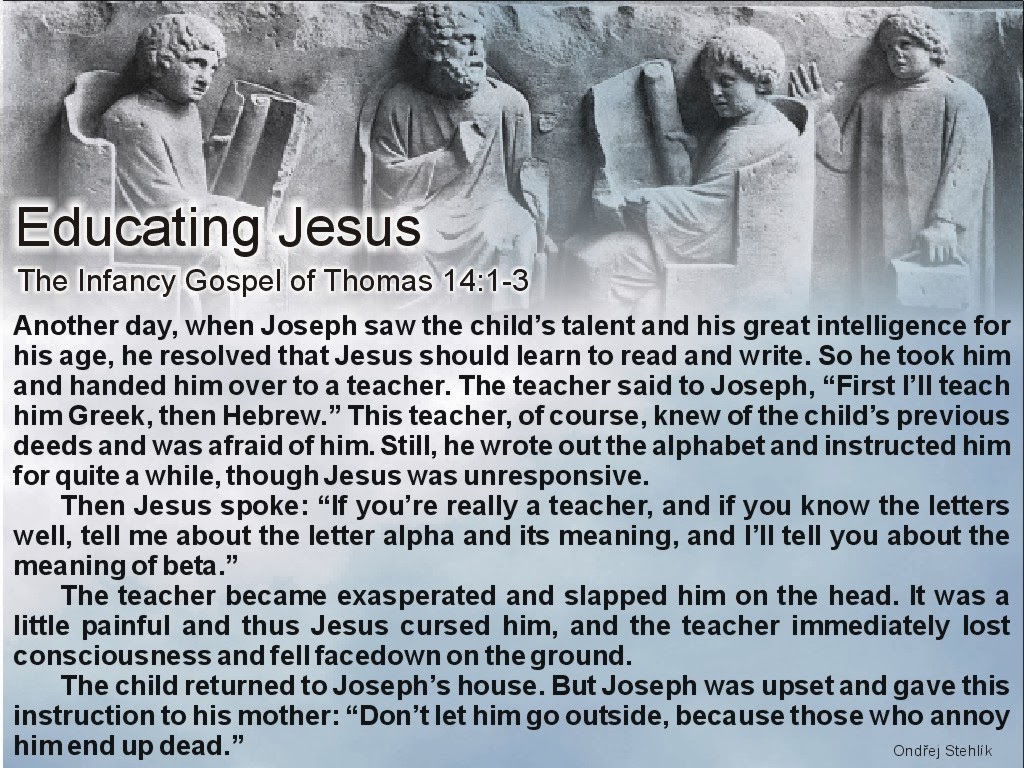
Jesus - the pesky child prodigy!

(Renewal - Newsletter article) 
When this boy Jesus, was five years old, and there came a storm, so he was playing at the wade of a brook collecting the streams of water into small ponds. And then he made that the water was instantly pristine. And understand that he did this with a single word!
He also made himself soft clay out of mud and shaped it into twelve sparrows. And it was on the Sabbath day, when he did this. And many other boys were there who were playing with him. But then a Jew saw what Jesus was doing on the Sabbath day, as he was playing. So he immediately ran off and tells Joseph, his father, “See here, that your boy is at the wade and has taken mud and fashioned twelve birds with it, and so has violated the Sabbath.”
    So Joseph went there, and as soon as he spotted him he shouted, “Why are you doing this what’s not permitted on the Sabbath?”
    But Jesus simply clapped his hands and shouted to the sparrows, “Be off!” And those sparrows really took off and flew away chirping.
    And those Jews seeing it they were amazed, they ran and reported to their elders, what they had seen what Jesus did.  
(Text collated from several ancient and modern translations and attempts to capture rather peculiar and folksy Greek original.)

          This legendary story about little Jesus is obviously not from the Bible! It is a famous quotation from The Infancy Gospel of Thomas. This non-biblical gospel is rife with primitive anti-judaism and wild interest in sensational miracles. Throughout it Jesus is portrayed as a “wonder-child” a miraculous prodigy with a petulant and subversive streak. These are all signs of late composition and the influences of the popular piety of the late Hellenistic centuries. Infancy stories hardly tell us anything substantial about the historical Jesus and his childhood. On the other hand, they are loaded with important theological themes and they tackle them in their own particular, legendary, fashion.     

          Their most formative feature is an awe of incarnation, utter amazement at the fact that God became human. How could it be? How would it work? What would it look like? In the gospel of Luke we have an account of a 12-year old divine child in the Temple. Infancy gospels take it even further back. How would this divine child look and behave at his school age, and even before? Their answer is highly entertaining and full of self-serving miracles. But their true answer is hidden in plain sight of their legendary narratives; the fact of incarnation, the theme of Advent and Christmas, that God became human, is beyond means of our intellect, beyond the limited powers of our imagination. The story which we celebrate on Christmas has always been and remains an utter approximation and true miracle of divine love. 

          And while those early Christians wondered at a divine child, they unknowingly started something very new. For the first time in human history a little child became a main character in a work of literature (Perhaps with the only exemption of the opening section of Xenophon's Cyropaedia). In these infancy gospels the childhood was lifted up from oblivion. Childhood, its playfulness, its mischievousness, its struggles, its creativity, its bursts of energy were given a central stage. Our culture is what it is, our education and our respect and concern and care for children are taken for granted, because people realized that divine incarnation (God becoming human) included 5-year-old Jesus!

          Particularly in our highly commercialized times the legendary little Jesus of our story can teach us even something more. Children as well as grownups do not need expensive gadgets and toys to trigger their playfulness. Making ponds on a brook, forming birds from clay. Those are almost proverbial simple joys of childhood which verge on true miracles of sheer imagination and unbounded playfulness. These legends invite us to the simple yet blessed joys of Advent and Christmas time.

This Advent and Christmas we will be following different non-canonical infancy gospel, the one ascribed to James. It is perhaps a little less entertaining than Infancy gospel of Thomas, but no less Mysterious, Miraculous, Mythical and and certainly no less Meaningful.


2013/09/08

Glacier lesson

This summer our volcanological hobby brought me and Martina to Iceland. On our first day we visited the Þríhnúkar (Three-summits) volcano. We went all the way to the highest summit and descended right down through the lava chimney to the large cavernous magma chamber. It was a special experience to be 400 ft. deep inside of an extinct volcano. But it was something we planned and expected.
       What I was not prepared for were the experiences on the opposite side of the temperature scale. Hiking on Langjökull, one of the largest European glaciers was truly breathtaking. It was the middle of summer, and as far as the eye could see there was nothing but ice and more ice, in some places 1,900 ft. thick. The sound and feel of a summer glacier is indescribable; it flows and it sings, it breaths and rings. Melodies of brooks and moulins (meltwater cascading into deep cracks) are part of the experience of a summer glacier. Unfortunately it has been melting faster than it can be replenished through winters.


Martina on Langjökull near group of  moulins.


       The next day we climbed Snöfellsjekull, a 4,744 ft. tall volcano also covered with a white cape of permanent snow and ice. (This is the volcano which Jules Verne picked as an entry point for the “Journey to the Center of the Earth” – and no, we did not find any entrances, only some lava tubes.) At first, our ascend of Snöfellsjekull was gentle on a dry volcanic tephra, but soon we transited to the glacier and the going got steeper and steeper. All the way up we could see the summit; it seemed so deceivingly close, but it was not getting much closer as if the mountain played tricks on us.
 

Glacier-covered stratovolcano Snöfellsjekull from distance of about 30 miles.


       But then, when we finally reached the summit, suddenly the full panorama opened up on all sides. It felt like a religious experience for us breathless hikers. First hand we could experience why so many important biblical events took place on the mountaintops. It is a combination of spiritual and physical breathlessness, it is a combination of spiritual and physical exhaustion and exhilaration, it is a combination of new and broader physical and spiritual horizons. Such experience never comes without strain; you have to climb the hill, you have to invest the effort - at the same time with that overwhelming panorama all around, you also know preciously well that your personal effort was only a small part of this profound reward.


Andrew near the top of Snöfellsjekull


       Yes, you have to commit, you have to invest your own energy, but you gain a manifold reward which is so difficult to describe in words; it has to be viewed and experienced, it has to be felt, like the gusts of wind, sparkling of ice crystals and views of land and ocean. It is a profound gift of eagle-like perspective.


Snæfellsnes (peninsula) from Snæfellsjökull (volcano)


       And then comes the time to return, time to descend down to the mundane life down below in the valleys. The descent can be as strenuous as the climbing up, and perhaps a little bit more dangerous; just watch for those ice crevices, some could be several stories deep!  But a returning person has been inwardly transformed, illuminated, with new perspectives, with broader horizons.
       I consider such mountain-hiking to be a fitting parable for our spiritual life, our spiritual life journey. The grace of our Lord is free, but it isn’t cheap! In our faith and in our life together as a church we have to invest our effort and physical as well as spiritual energy. Sometimes we might think that it is too hard and too steep, but in the end we receive manifold reward in refreshed minds, broadened views and deeper appreciation and love. So let us take a hike together through spiritually breathtaking landscapes, a hike for a stronger, committed and enlightened faith.

2013/06/04

New Faith Idiom

    Right before I left for a vacation this spring, I had a unique religious experience that was special, peculiar, and at the same time emblematic of our current times.
    I was asked to officiate at the wedding of Agus and Jeremy. Jeremy is nominal Episcopalian and Agus is Muslim born in Indonesia. They came to us at Rutgers encouraged by our mutual Jewish friend Wendy who attends meditation classes in our community programs, sings in our Church choir and is familiar with the inclusive and welcoming spirit of our community of faith and our deep respect for diversity and the unique.
    Thus, in the service we read from the Hebrew Bible, from the Greek Testament, and also from Al Qur’an in an exquisite celebration of deep genuine love. I have read from Al Qur’an in Church on several times before, but it has always been to illustrate a point in sermon. This time it was different, not intellectual, but worshipful. The reading from Al Qur’an was an integral part of liturgy. You most likely know the Song of Song and the Song of Divine Love from Corinthians, our Bible readings, but American knowledge of Qur’an is not to be automatically expected, so here is the quotation from Surah 30:
       “Among divine signs is that God created you from earth,
       and you are now human beings dispersed everywhere.
       Another of divine signs is that God created mates
       of your own kind of yourselves
       so that you may get peace of mind from them,
       and put love and compassion between you.
       Verily there are signs in this for those who reflect.
       Among other divine signs is the creation of the heavens and the earth,
       and the variety of your tongues and complexions.
       Surely there are signs in this for those who understand.”
(And I care little that the original Arabic, being a genderized language, has “mates” in female form, it is just a legitimate hermeneutic shift to apply it in our modern times and gender neutral culture to same gender relationships.)

    The same spirit of appreciation of love and diversity shaped this unique worship throughout. Jeremy and Agus now live in Bali and thus for the wedding processional and recessional music they chose the Gamelan Semar Pegulingan. It’s a special music played in honor of local Balian Hindu god Semar, a deity of good fortune and love.  I had never really known it and it instantly caught me by my heart, it is so different and ethereal. This music is played on ancient instruments and in very unique archaic seven-tone scale. This particular live recording even had Balian crickets chirping along on the background! (This link does not lead to identical composition or recording but can give you some idea.)
    Even further in this inclusive spirit, we opened the worship with an old Asian tradition of burning incense to honor ancestors and include all the distant and absent friends and relatives who could not join this celebration. We used the singing bowl to mark this important transition in their lives and entrusted the couple to each other and to AGAPE - the divine love in all this diversity of religious traditions, readings, accents, sounds and smells.
    I find this joyful worship experience symptomatic and hopeful. Nolens volens (like it or not) the world is getting more and more global, interconnected and complex. Jeremy and Agus are almost an embodiment of this reality. World religions, each with its own exclusivist claims, struggle to accommodate while alienating individual people in the process. (Can you imagine any imam marrying a gay couple?!). Hardly anywhere else is this reality more evident than in the cosmopolitan metropolis like NYC. Fundamentalists of all different stripes might try, but they cannot stop it. It is a tectonic shift in the cultural global scale.
    In our church we are now entering process of listening and gathering insight from our broader community and discerning what God is calling us to be and do. This might be an important spiritual part of this process. Where is the balance between exclusivist doctrines and rituals and the inclusive spirit of broad welcome? Where is the balance between doctrinal and ritual integrity, as important as they are, and the disarmingly inclusive spirit of Jesus, who did not care about human labels, but cared for the well being of people beneath the labels of Samaritans, Phoenicians, Romans or Jews? While a dwindling number of traditionalists inside as well as outside might like the church “as it always used to be,” a growing number of people are left outside to their own devices, alienated, spiritually hungry and searching with very little help.
    The Divine Spirit is as always at work among people,  and She is steering the hearts of people. Do we have courage to learn, to listen and to love (AGAPAO) with open minds?

By the way, conservatives in our own Presbyterian denomination are all worked up about preserving the purity of what they call CHRISTIAN marriage. Our wedding ceremony certainly did not fit their narrow definition of “Christian”. How should the inter-religious marriages be categorized and celebrated? In our ceremony we all tried our best to be faithful to the inclusive spirit of Jesus and his deep respect for human longing for wholeness, acceptance, and divine presence.


2013/05/21

Ground the drones now!

Warnings from Modern Prophets (SciFi Writers)
    In 1920 the Czech writer and playwright Karel Čapek coined the word ROBOT in a very early science fiction play called R.U.R. (Rozum’s Universal Robots) - here is an English translation. In this play, human engineers created artificial biological beings; today we would called them “androids”. Čapek called them Robots, deriving their name from an old Slavic word for servitude. In his dystopian vision Robots were ever more severely exploited and finally used to fight human wars until they rebelled, and turned against their creators and eliminated the human race. Only in the very last sentences of the play, in the epilogue, is there a glimmer of hope, when a couple of the most human-like robots with procreation ability are sent out to start a new human-like race.
    A great number of science fiction writers were always weary of the human propensity for doing evil and the ability of their technological creations to reflect and even amplify this destructive ability. That was the reason why famous American Science Fiction writer Isaac Asimov formulated, as early as in 1942, three basic laws of robotics:
  • A robot may not injure a human being or, through inaction, allow a human being to come to harm.
  • A robot must obey the orders given to it by human beings, except where such orders would conflict with the First Law.
  • A robot must protect its own existence as long as such protection does not conflict with the First or Second Laws.
In theoretic and fictional ways writers and thinkers explored and further perfected these laws. In thought experiments it became obvious that the absence of these or very similar laws has dire consequences for human culture and even existence.
    Why do I write about it? Because such dystopian development is becoming a very current possibility. The American military (and even the C.I.A.) have been operating for years drones equipped with weapons. They have killed thousands of people (often civilian women and children bystanders) in Pakistan, Afghanistan, Yemen, Somalia and who knows where else. As morally problematic (even corrupt) as this form of warfare might be, until recently these drones were remotely operated by humans - officers working in shifts. But the military has a serious problem, even “well trained” (understand patriotically brainwashed) officers are not completely immune to human feelings. The human element, even if kept safe and isolated in distant rural military bases, turned to be the weakest element of this murderous strategy. It is a chronically under reported fact that the units of drone operators have serious burnout and drop-off problems (some of the original drone pilots or gunners even becoming difficult vocal opponents). And thus, lately it has been reported that the military and its DARPA (Scientific defense agency) started to play with an idea of eliminating the human factor all together. There is a real danger that soon we will have true killing machines independently calling shots unburdened with such “useless” complications as conscience and moral feelings. And of course they will be unhindered by any such thing as the Basic Laws of Robotics in any of their forms. You do not need to be a fan of Science Fiction to see where it can take us!
    I am getting increasingly worried. It is time to start listening to biblical as well as modern prophets. Biblical prophets warn us against human evil, greed, aggression, militarism and imperialism. Modern prophets (SciFi writers) explicate how human moral flaws can be expanded and multiplied by technology. We should take their conjoined warnings seriously and insist on having the three basic laws of robotics integrated into every artificially intelligent machine.

Isaac Asimov 1920-1992

2013/04/10

Pirates of the Galilean

In Sunday sermons, and even greater depth in our Sunday morning bible classes, we have been engaging in cutting edge biblical theology. In the field of New Testament scholarship it has been called the Third Quest for the Historical Jesus. In the last decade or so biblical scholarship has substantially changed our understanding of Jesus and his time. It is an exiting time, because this scholarship supports the social stands of our congregation and can further integrate social justice advocacy with most recent theological scholarship. Even a common image of Jesus on a fishing boat can suddenly convey a quite radical social message.
 
Do you know that there was a naval battle in ancient Galilee between Jews and Romans?

        Josphus Flavious reports this event in his book De bello Judaico (Jewish War III.10 [497-515]). He describes how in the year 67 C.E. the Romans captured the fortified city of Tarichess (also known as Magdala). He relates how some of the Jewish resistance fighters escaped in boats on the Galilean lake and how the Romans chased them down the next day and defeated them in the first but last known Galilean naval battle. Josphus attributes the Roman victory to their superior ships, while the boats of the Jewish resistant fighters were, according to him, good only for piracy.
        This mention of piracy could be considered just a standard schematic denunciation of any sea-born opposition. One can hardly envision any true piracy on a lake, because you can easily see from shore to shore. On the other hand this inadvertent remark could be quite close to reality and interestingly illuminate Jesus’ life and ministry.
        In year 1986, two brothers - Moshe and Yuval Lufan - discovered the remains of an ancient boat in the Galilean lake near modern Migdal (ancient Magdala). The boat rested in shallow water and had been covered and preserved by mud since the first century C.E. It was retrieved and painstakingly reconstructed and now is on display in the museum of Kibbutz Ginossar. 

       The boat was about 27 feet long and 7.5 feet wide. It carried five crew members, in addition, it could carry about a ton of cargo or ten passengers. The boat's bottom was nearly flat, permitting it to be used close to the shore. It could also easily land and be pulled out of water on shore - all properties sought after by fishermen and pirates alike, giving them opportunity to embark and disembark, to appear and disappear almost anywhere along the shore. One more detail was interesting: the boat was patched together from fourteen different kinds of wood and most of it was reused - salvaged from other older boats. Evidently in the first century even the ship owners lived under severe economic pressure.
       Now think about Jesus. He called fishermen as his disciples, preaching from their boats moored by the shore, appearing in villages and towns around the lake, embarking and disembarking along the shore, often on the deserted places. You cannot avoid thinking he was escaping across the lake, crisscrossing the lake often by night. I am not implying he was a leader of any true pirates who robbed other impoverished fishermen and struggling merchants. Jesus was someone much more glorious and dangerous at the same time. He was a preacher and healer with a message of the kingdom of God, with an incendiary message of a new order built on abundance found in sharing, plentiful divine grace, stigma lifting healing, peace and the justice of God. He was reconnecting impoverished, dispossessed, alienated people, offering them acceptance, restoring their self esteem and their integrity and bringing them hope.
      The economically stressed and disenfranchised fishermen recognized this otherworldly grace. They allowed him in their boats, they let him preach from their boats, they offered him the skills and protection of old salts. It wasn’t just a regular piracy, it was an intellectual, spiritual, gospel driven piracy, the most noble, gentlemanlike piracy. This is a piracy which is still needed even two thousand years on, desperately needed on our noodle-shaped island and along the Hudson Bay shores. People still need to hear and experience feeding of multitudes, gaining liberation and healing from political and financial oppression, liberation from evil spirits of selfishness, greed, negativity, vindictiveness, etc. We still need to bond against the powers of destruction in the name of divine grace. On Sunday mornings in bible classes and in worship we continue in this subversive quest for justice, peace and healing.
 

A Quiz Question: In a sermon and in several bible classes I have mentioned tangentially that fish from the Lake of Galilee were processed in coastal towns on an industrial scale. What was the major product and export article of this Galilean fish industry? You can give me any ancient name of this article or even only its description. Please send me answers to  astehlik@rutgerschurch.org .


A chart of the different kinds of wood used in this ancient boat. The boat was clearly repaired several times and at times with a reclaimed wood. This further underlines reality of a financially depressed fishermen.  


This article was published in Renewal - Rutgers Presbyterian Church Newsletter in Spring 2010.

2013/02/21

Jesuses and their tombs

In March 1980 a construction company was building an apartment house in Jerusalem. They accidentally uncovered yet another burial cave - a Hellenistic tomb. Archaeologists were called in and they conducted the obligatory rescue excavation. They didn’t find anything out of the ordinary and thus the report was published only several years later (1994 and 1996). It took another decade before journalists and media took notice. A few years ago, around Easter time this quarter-century-old archaeological discovery suddenly became a hot media topic. The tomb became a sensation because it contained ossuaries (stone boxes for bones) inscribed with names known from the gospels. One ossuary even carried the name “Jesus son of Joseph”.
       Beyond doubt, this was a tomb of Jesus, in which he lay until his body decomposed and his bones were gathered in this ossuary. But one thing has to be noted right away - for us Jesus is quite a unique name, and thus generated so much media attention. Today Jesús is a common personal name only in Ibero-America (Hispanic America). In New Testament times Jesus was the fifth, perhaps even the fourth most common Jewish name. It was a common version of the biblical name Joshua. And it had profound religious and especially political significance - the name means “The LORD (is) salvation/liberation.” One can understand why it became so popular under the brutal circumstances of the Roman imperial occupation. The second most popular male name of those times was Joseph. This name was given to babies after a patriarch who survived captivity, conquered a foreign empire, and delivered his family from destitution. This political name-giving expanded also to female names. The second most popular name was Salome - derived from the Hebrew word for peace, and the third most popular name was even more direct - Shelamizon which means “Peace from Zion.”
       In the New Testament times, in times of Jesus from Nazareth, about every eleventh man or boy was named Jesus and every seventh was Joseph, while every fourth or fifth female was Mary. There were thousands of Jesuses! A discovery of a tomb of Jesus is not anything surprising. Even the presence of other biblical names in that cave is not particularly surprising. Jesus was a common name of uncommon hope for deliverance, justice and peace in the midst of despair. Time was ripe for a quantum step of new divine deliverance.
       Thus finding a tomb of Jesus son of Joseph is not any big surprise. A true surprise would be to find a tomb of the crucified Jesus, or for that matter a burial of any crucified person. But that will open a completely new theme for another article. We plan to talk about it and about the mystery and powerful symbol of empty tombs in our last Lenten Lecture. I would like to invite you to all of the lectures. 


2012/11/28

Incarnation mystery

Some time ago a fundamentalist “inquisitor” tried to test my orthodoxy and interrogated me about the divinity of Christ (ministers occasionally receive these kinds of strange telephone calls. You might have had similar experiences with your more conservative relatives, friends, or coworkers.) Holy innocence, I wondered, they are truly hopeless, what a pudding-head question! Not the divinity but the humanity of Christ constitutes the greatest theological mystery. Anselm of Canterbury (1034 – 1109) marveled: Cur Deus Homo - Why God (became) Human? I am not particularly fond of his motives and conclusions, but his question outlines the true mystery of incarnation. The Gospel of Matthew (1:22f) approached this mystery by referring to the prophecy of Isaiah 7:14:

Therefore the Lord himselfe will giue you a signe. Beholde, the virgine shall conceiue and beare a sonne, and she shall call his name Immanu-el. (I quote in the delightful Renaissance English of the Geneva Study Bible.)

Immanu-el, Immanuel or Emmanuel means “God with us”. But who was the original “God-with-us” of the Isaiah prophecy? No one really knows. The Prophecy was most likely directed to Jerusalem’s King Ahaz. The sign was to be the conception and birth of a royal baby to a young noblewoman (this is the exact meaning of this word (g'almah/t) in old Semitic languages, not a virgin but a young noblewoman). Who was this young noblewoman and who was this baby boy? She was probably one of the king’s wives and the boy was his son; some point to Ahaz’ son and successor king Hezekiah, but it is not certain; only a few names of queens and very few names of their children survived. Their original identities remain a mystery. But we can know other things with greater certainty. Isaiah himself had already quoted and combined several older religious formulas. The pre-biblical myth from Ugarit (KTU 1.24.8) used the identical childbearing phrase of hope: “a noblewoman will bear a son...” Biblical legendary stories record a similar hope-inspiring name-giving angelic prophetic instructions: “You will have a son and will call his name....” (Gen 16:11). All these ancient archetypal references point towards a powerful message of hope in the birth of a child. Why would the birth of a mythical baby, a royal baby, Mary’s baby, or any baby, mean that God is with us? It remains a central mystery of incarnate divine love.
    Indeed, not the divinity of Christ, but the humanity of God has been one of the deepest mysteries of divine love. How and why is God coming in the form of babies? How does it transform our view of the world? Why is God bringing help and hope by becoming one of/with us? What does it mean, that God is human? What does it mean for our ethics, for our personal, social and political behavior? But even further, why is the creator becoming creation? What does it mean to eliminate this important conceptual distinction? What does it mean for our relationship towards creation, other creatures, and the natural world? Isn’t it possible that by asking these questions our perspectives and our lives are already being transformed and hope is being born and reborn?


2012/09/06

Turning the world upside down

I have been always intrigued by the magical plasticity of our perception and how it alters our understanding of the world and informs and broadens our decision making. Take for instance the famous upside-down perception experiments. Neuroscietists fitted people with semi-permanent goggles which turned their vision upside down. Understandably, first several days were almost unsurvivable for everyone. On the fourth and later days participants started to cope and soon they lived almost as if they did not wear these perception altering glasses, they were even able to ride a bicycle for instance. When they took the glasses off again, their perception returned instantly or soon.
       As I am writing this article, we are returning from summer holidays in Dominica, an island member of the British Commonwealth. It is an almost dizzying experience to drive on the left side of the road. It vividly reminded me of my seminary year in Scotland. Driving on an opposite side of the road is difficult, strangely, being a pedestrian, is not much better. For a day or two I did not know where to look first. Many times over I was surprised by honking and occasional squeaking of the brakes coming at me from strange and “wrong” directions. After about two days it got better.
       Our view of the world, our inner image of the world and our position in it is result of our psychological and cultural influences and viewpoints. For instance, do you know, how Australians view the world? It isn’t upside down, but it isn’t so much different. Just look at Australian maps! I had a very early introduction to the Australian world view because my first English teacher had some Australian friends.
       In her classes she liked to use some nicely printed travel magazines from “down under.” These magazines also included world maps with an “Australian spin”. These world maps were not drawn around the Atlantic basin – to the contrary - in them the Atlantic laid on the edges of the world and the Pacific basin and Australia were at the center, or very close to it (actually the 150th meridian was the center line. It looked something like this:


Thus in the third or fourth grade I learned to appreciate the fact, that the image of the world is a reflection of our cultural and psychological predispositions, and our cultural and educational influences. Australians do what we all do - view ourselves in the center of the world.
       Unfortunately many people are mentally lazy, and thus are not conscious of this fact. In addition, their world can be quite small, even in one of the largest metropolises of our planet. Mental images of the world for many people are built around their persons and don’t reach beyond their longest shopping trip.
       Thus, looking at the world from different positions and angles can be a healthy mental, cultural and spiritual exercise. As a permanent visual reminder I have in my church office a map which looks something like this:


       This map is arbitrary like any other cultural convention, yet how profoundly it can change our perspective of the world. Momentarily it can put us out of balance. However, it can help us to realize how much our outlook is a self-centered cultural prejudice. Expanding our personal horizons can lead us to become more humble and open minded, especially when we realize it is not just an intellectual prank, it is a lived reality.
       True Christian faith, faith, which is not just another cultural convention or ritual, real faith, deep and unpretentious faith which enjoys and welcomes challenges, is a prime example of life changing and dimensions expanding experience. In the moment when we encounter it, it can give us headaches because it has tendency to turn everything upside down. A first reaction is often rejection or dismissal, but when taken in as a challenge and processed and accepted, this transformative faith has the potential to broaden life and change life perspectives. In our open-minded and progressive faith we go against the stream of our environment (either secular or conservative Christian). We continue turning expectations, conventions and prejudices on their heads and thus continue living our Christian faith openly and honestly.

(The Renewal, Autumn 2012)

2012/03/26

Poetry of coincidences and social nets

       Ivan Blatný was a young promising Czech writer and poet. Then, in 1948, the Communists took over power and he escaped to England. Uprooted from his home, language, family and friends, he was completely lost, and he experienced recurring episodes of disorientation. The British National Health Services sent him first to a psychiatric hospital and then to a sanatorium. By the time he got to that sanatorium, no one around him knew that he was a published poet (although in another language).
His constant scribbling on any piece of paper he could lay his hands on was seen as part of his peculiar eccentricity. Many decades later, one of the nurses payed attention to his scribbles. Ivan was rediscovered as a literary figure. After many years spent in the sanatorium he remained there until his death, but he was able to publish two more excellent collections of highly interesting code-switching poetry (part Czech, part English).
       When I came to Rutgers, there had been a homeless man sleeping regularly on the church steps. He was very shy. Not many people noticed him and even fewer managed to speak more than a sentence with him. He would come quite late and get up early and would always sleep right by the door. The custodial staff kept an eye on him, helped several times to store his stuff, and they protected him a few times. Our good-hearted accountant, Tina, gave him some warm clothing and one winter she bought him a sturdy sleeping bag. He did not take it right away, waiting for several months. He really was very shy. Once or twice, when it was bitterly cold, we had to call #311 for shelter responders, we were worried he might freeze on our steps.
       Over the last summer an elder of our church started to bring him breakfast and established and built up trust and a relationship. Thus we learned quite a surprising story. His name was Mirumil (Not his real name, although also Slavic), and he was originally from the Czech Republic (Czechoslovakia at that time). He escaped to America shortly after the Russian troops crushed political hopes during the Prague Spring of 1968. At that time he studied mathematics at the university. Here in NYC he got by by taking some menial jobs. Uprooted, without family, or any close community or friends, something happened. He lost his documents, job and home and ended up on the street.
       When I started to write about it, the church elder expressed it very nicely: “In reaching out and doing small things, we can individually make real differences in other people's lives. The first morning I brought Mirumil breakfast, I had just learned that my uncle had passed away after a battle with cancer. Events like this make you focus on what is truly important -- life is short and we have value through serving others and doing God's work... we have the power to take actions which can have real impact.”  
       In the autumn we celebrated Mirumil's 65th birthday. Our elder prepared a delicious honey cake. And while we ate it, we learned more helpful details. Mirumil was born in a small city in Moravia. I knew that place, because my best friend grew up there. Mirumil’s high school teacher, who inspired him to study mathematics, was my friend’s school headmaster. With a little bit of internet searching I was able to find out and communicate with the city registry office and soon we got a copy of Mirumil’s birth certificate. By that time he also agreed to go to a shelter without risking another winter on our steps. Meanwhile the elder initiated the process toward the recovery of his SSN and his immigration card. As soon as he had all the documents, we hoped to help him find some more permanent accommodations and work.
       As uncommon as it might look, Mirumil’s American part of the story is unfortunately quite normal on several counts. As my friend Laura, who has been professionally serving and helping homeless people for many years, reminded me: 1) Wherever safety is found, that becomes ‘home’ (Rutgers Steps), 2) It takes months to develop trust and trust can only come with patience and kindness and no demands. 3) when trust is developed, there is always a thread of connection (in this case a skein) 4) It takes 6-10 people to house one individual who has been living on the streets.
       And this observation clarifies why I intentionally built this column on the juxtaposition of stories of Ivan and Mirumil; they are similar, and they are different. Thankfully both have positive outcomes. But I still wonder: How is it possible that an episode of disorientation and vulnerability (Ivan’s case was actually medically more serious!) could have such diametrically different solutions?
       Society becomes compassionate and humane in two complementary ways: by being composed of many dedicated and compassionate individuals, but also by putting in place adequate government-guaranteed social safety nets. As a person coming from abroad who still can claim a certain“outside” perspective, I have been always deeply moved and impressed by the American spirit of volunteerism, individual compassion and help. Similarly I have often been surprised and even shocked by how little attention is given to systemic social and medical matters.
       Those two aspects are like two legs of our society: without training and using both of them simultaneously, our society cannot run or walk, it can only hop and hope. When I recently heard some presidential candidates seriously proposing to a innumerable claque that the social services should be built only on volunteer basis and available only to citizens, I realised that we might be hopping and hoping for a long time.
       I sincerely wish that Rutgers will be a place where we learn to walk, run, skip, jump and launch ourselves into a positive future for all people, and especially those in greatest need of our compassion. 
This was written in spring 2012
--------------------------------------
THE STORY CONTINUES
On Monday, the 2nd of December 2013, I received a check with a donation for our church. It was a personal check from Mirumil! I can hardly describe my emotions as I wrote him a thank-you card. 
Mirumil now has a permanent resident card and got his SSN back. We keep in touch as he stays in WSFSSH transitional home at Valley Lodge waiting, any moment now, for his permanent home!
Thank you to Dermonte, Tina, Nancy, Laura, Lili and many others!

---------------------------------------------
THE STORY CONTINUES FURTHER
On Thursday, the 20th of March 2014 Mirumil moved to his apartment in Euclid Hall, right on the Broadway and 86th Street - one of the WSFSSH houses. Today (Saturday 22) I brought him some basic homewars for an improvised homewarning party. Welcome home, Mirumil!

2011/11/22

Radical Advent Prayer

Do you know that every time when we say the Lord’s Prayer, we pray for Advent?
The second request of the Lord’s Prayer in Latin reads: “Adveniat Regnum Tuum.” In English: "Your kingdom come." 
     It’s clear that we are not praying for the speedy arrival of the pre-Christmas season with its whipped up consumerism and slowly awakening seasonal sentimentality. We pray and we await for a different advent. The advent of God’s kingdom! We pray for a radical change in how the world operates. How radical? Very radical. Just let us decipher and hear afresh the requests of this "advent" prayer.

Your will be done on earth as it is in heaven.
What divine will is done in heaven, that is not done on earth? 
Well, we can start with the divine protection of all the vulnerable and the weak. In the Bible they are called widows and orphans. Their protection is so important to God, that it is repeated over and over again in the Law and by the Prophets. In the New Testament it even necessitated a complete reordering in the hierarchy of heavenly bureaucracy. Guardian angels of the little ones were lifted up into the presence of God, replacing the big shots of the cherubim and seraphim with all the archangels. (Matthew 18:10). 
       Just imagine elevating social services (guardian angels) before the ministry of war (I resist using that misleading euphemisms of ministry of “defense”). Just imagine, on a personal level, supporting the local food pantry and homeless shelters before leaving for Christmas shopping.  Modeling our lives according to heavenly orders – that is what we pray for in Lord’s prayer. This is the Advent we seek.

Give us this day our daily bread.
Hunger in Jesus’ Galilee was as real as it is in our world. These words were intended for, and were originally said, by those who were hungry or lived from day to day. For many of us, who are not hungry, these words have a different meaning. We pray for the coming of a world where everyone has enough and world abundance is shared each day. No one can expand his or her life by simply hogging up extra food or resources, (the main lesson from the story of the stupid wealthy farmer in Luke 12:13-21). 
       And no one can eat paper money, bonds, or bricks of gold. Ultimately all of it, in some way, is a social and societal (or if you wish economic) agreement that we will care for one another. Just imagine eliminating all the private commercial retirement funds and building up one robust and generous solidarity system. Anyway, it is always today’s generation that cares for the past one, and trusts to be cared for by the future one. Solidarity, sharing and mutual care is the daily bread we pray for and look for during Advent.

And forgive us our debts as we forgive our debtors.
Very appropriately, in our tradition, we use the words "debt and debtors."
Do you really believe that God was ever seriously concerned about anyone trespassing on someone else's property? We do not live in medieval England any longer. We are not warlords of dark ages for whom pillaging and trespassing was a capital offense. 
Similarly, the understanding of sin got highly spiritualized, psychologized, and detached from world’s everyday reality. Meanwhile, debts were clearly very close to God’s heart from the oldest of times.
       There are many biblical rules that attempt to control debt. Every seventh year there should be a remission of all outstanding debts (Deuteronomy 15:1f.) And the release of any debt slaves. (Deuteronomy 15:12f). In the agricultural society, the growing disparity between rich and poor was controlled by instituting a Year of Jubilee when all the land property was restituted to its original owners or their heirs.(Leviticus 25:10). Translated into our context, we pray and anticipate an advent of a world with lenient bankruptcy laws, a world where lending and mortgaging is controlled and regulated to protect the poor. We pray and promise not to torment or enslave anyone through money; freedom and relationships have precedence over money.

This is our Advent prayer: We pray and wait for the protection of the most vulnerable, for solidarity in sharing life resources, and for the elimination of enslaving debt. These are just three aspects of a radical divine world that we anticipate in Advent. So let us pray “Adveniat regnum tuum.”