About this blog

This Blog is named after an ancient gnoseological riddle which hints hidden, disseminated, omnipresent wisdom.
I invite you to search, listen and observe with me for "the word of tree, whisper of stone, and humming together of the abyss and stars."

2013/12/12

Jesus - the pesky child prodigy!

(Renewal - Newsletter article) 
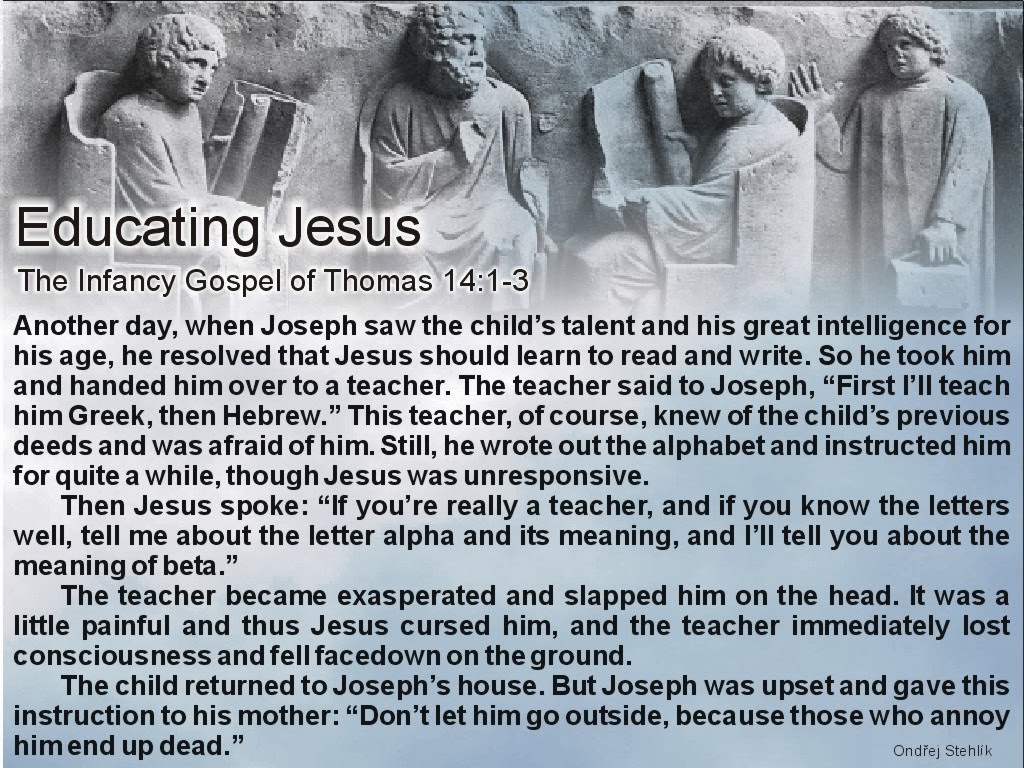
When this boy Jesus, was five years old, and there came a storm, so he was playing at the wade of a brook collecting the streams of water into small ponds. And then he made that the water was instantly pristine. And understand that he did this with a single word!
He also made himself soft clay out of mud and shaped it into twelve sparrows. And it was on the Sabbath day, when he did this. And many other boys were there who were playing with him. But then a Jew saw what Jesus was doing on the Sabbath day, as he was playing. So he immediately ran off and tells Joseph, his father, “See here, that your boy is at the wade and has taken mud and fashioned twelve birds with it, and so has violated the Sabbath.”
    So Joseph went there, and as soon as he spotted him he shouted, “Why are you doing this what’s not permitted on the Sabbath?”
    But Jesus simply clapped his hands and shouted to the sparrows, “Be off!” And those sparrows really took off and flew away chirping.
    And those Jews seeing it they were amazed, they ran and reported to their elders, what they had seen what Jesus did.  
(Text collated from several ancient and modern translations and attempts to capture rather peculiar and folksy Greek original.)

          This legendary story about little Jesus is obviously not from the Bible! It is a famous quotation from The Infancy Gospel of Thomas. This non-biblical gospel is rife with primitive anti-judaism and wild interest in sensational miracles. Throughout it Jesus is portrayed as a “wonder-child” a miraculous prodigy with a petulant and subversive streak. These are all signs of late composition and the influences of the popular piety of the late Hellenistic centuries. Infancy stories hardly tell us anything substantial about the historical Jesus and his childhood. On the other hand, they are loaded with important theological themes and they tackle them in their own particular, legendary, fashion.     

          Their most formative feature is an awe of incarnation, utter amazement at the fact that God became human. How could it be? How would it work? What would it look like? In the gospel of Luke we have an account of a 12-year old divine child in the Temple. Infancy gospels take it even further back. How would this divine child look and behave at his school age, and even before? Their answer is highly entertaining and full of self-serving miracles. But their true answer is hidden in plain sight of their legendary narratives; the fact of incarnation, the theme of Advent and Christmas, that God became human, is beyond means of our intellect, beyond the limited powers of our imagination. The story which we celebrate on Christmas has always been and remains an utter approximation and true miracle of divine love. 

          And while those early Christians wondered at a divine child, they unknowingly started something very new. For the first time in human history a little child became a main character in a work of literature (Perhaps with the only exemption of the opening section of Xenophon's Cyropaedia). In these infancy gospels the childhood was lifted up from oblivion. Childhood, its playfulness, its mischievousness, its struggles, its creativity, its bursts of energy were given a central stage. Our culture is what it is, our education and our respect and concern and care for children are taken for granted, because people realized that divine incarnation (God becoming human) included 5-year-old Jesus!

          Particularly in our highly commercialized times the legendary little Jesus of our story can teach us even something more. Children as well as grownups do not need expensive gadgets and toys to trigger their playfulness. Making ponds on a brook, forming birds from clay. Those are almost proverbial simple joys of childhood which verge on true miracles of sheer imagination and unbounded playfulness. These legends invite us to the simple yet blessed joys of Advent and Christmas time.

This Advent and Christmas we will be following different non-canonical infancy gospel, the one ascribed to James. It is perhaps a little less entertaining than Infancy gospel of Thomas, but no less Mysterious, Miraculous, Mythical and and certainly no less Meaningful.


2013/12/06

Mysterious Abstinence

Why did early Christianity get so preoccupied with virginity? Where did this preoccupation come from? Why did early Christians get so heavily invested in celibacy? Why did it take off so quickly and become one of the characteristic features of the early church. And, please understand, I am not speaking about medieval superstitious and manipulative piety, I am not speaking about celibate priests or eremites and monasteries; all of that would come in full force centuries later. But where did this strong interest in celibacy in early church come from? As strange as it might sound, scholars are finding out that it was part of a revolutionary, contra-cultural and subversive movement.
    Just imagine that you live in a society where you are married or given to marriage by your paternal grandfather or even worse, by some distant great grand uncle. And even if you are free of your family clan or you are the head of it, just imagine that you are forced by the imperial laws to marry, and you are severely and legally penalized if you don’t. Just imagine that you are forced by the law to have multiple children and you are persecuted by the state if you decline to procreate. I do not know how about you, but I would be quite unhappy and even inclined to resist, simply on the basis of being under legal pressure.
    That was exactly the situation in the Roman Empire from year 17 B.C.E. and especially from 9 B.C.E.. The Emperor Augustus declared the family and moral laws (Lex Julia de maritandis ordinibus) and particularly Lex Papia Poppaea. These laws forced specifically Roman citizens, but indirectly all Roman subjects, to marry and have children.
    This was the societal context. While Ovidius rebelled by highlighting promiscuity, early Christians lifted up virginity and defended celibacy; as I have said, it was their contra-cultural stand. In the name of their religion, they claimed control over their bodies, and they asserted their sexual freedom. It was their rebellion against patriarchal societal mores and inappropriate paternalistic political pressures. As strange as it might sound, it was their religious sexual revolution. (By the way, the radical separatist feminism of XX century, for instance  “Cell 16”, also followed similar, although secular, path!).
    This Sunday the Gospel of James will help us to look at where this ancient virginity and celibacy originated and what it might mean today, concerning our current social and legal pressures and how we can rebel, subvert and change them.
----------------------------------------- 
And I know about underlying influence of Hellenistic Platonism with its stark distinction between body and spirit - the dualism which found its full expression in Gnosticism. 
The miraculous virginal birth at the center of Christmas Story certainly also contributed (regardless being misrepresentation of Isaiah’s prophecy). The Apostle Paul’s eschatological pragmatism, “why to marry if the end is near?” played also significant role. But all of this does not explain this cultural phenomenon of the second and third Christian centuries.


2013/11/29

Medieval Faith Comics


On the bulletin cover this Sunday we will have this beautiful renaissance painting. But besides being such a gorgeous piece of art it simultaneously provided religious education for illiterate medieval people in a form we could easily describe as Faith Comics (a story and a dialogue in a picture). Only instead of modern text-bubbles we have here inscribed scrolls (also called banderoles or phylacteries). 

The angels on the roof are setting the scene. They sing Glory to God in the highest, and on earth peace to people, good will!
Then we come to two female figures on the right side - they are two midwives. The kneeling midwife was named as Azel (or more commonly known as Zebel) and she says in utter  amazement, A virgin bore a son!
The standing midwife was named Salome and in the picture she says, I will not believe unless I probe. And as a consequence of her disbelief, Salome’s hand withered and she suffered a terrible fiery pain in it. She publicly repented and was advised by the white angel, Touch the boy and be healed!
 
Of course you cannot find this story of two midwives at the nativity scene in any of the gospels from the New Testament. The oldest version of this story is preserved in the noncanonical Gospel of James. This ancient Gospel, as old as some parts of the Bible, is miraculous, mysterious, and mythical in the most exaggerated manner. And exactly as such it can help us fully understand and appreciate the true nature, origins and meaning of the Biblical Christmas stories. These old Biblical as well as extrabiblical stories bring up important spiritual, theological and philosophical themes in the form of thrilling and entertaining, almost slapstick narratives.
 
-----------
And by the way, the hem of Mary’s cloak is also inscribed with a Latin text: SALVE REGIN[A MATER MISERICOR]DIE V[I]TA DVLCEDO ET SPES NOSTRA SALVE AD TE CL[AMAMV]S EXVLES FILII EVE AD TE SVSPIRAMUS GEMENTES ET FLENTES IN HAC LACR[IMARVM VALLE]. It is a famous Mariological hymn and prayer: Hail, (holy) Queen, Mother of Mercy, Hail Sweetness, Life, and our Hope! To thee we cry, banished children of Eve, to thee we sigh, mourning and weeping in this valley of tears.
-------------
And for those who are interested in the legendary story of two midwives, here it is from the Protoevangelium of James. This link leads to the Greek text and below are chapters 19+20 in a dynamic equivalent translation. The first person of this narrative is Joseph:

    And at that time a woman was coming down from the mountains and she says, "Man, where are you going?" And I said, "I am seeking a Hebrew midwife." And she said, "Are you from Israel?" And I said, "Yes." Then, she said, "In that cave, who is giving birth?" And I said, "My fiancĂ©." "So she is not your wife?" She asked. And I said, "She is Mary, she was raised in the temple and given to me by lot to be my wife. But she is not my wife, and the child she expects she got from the Holy Spirit." And she is like, “Sure!” And Joseph said, "Come and check it up yourself."
    So the midwife went with him. And they stood near the cave and a dark cloud of bright light hovered over the cave. And the midwife said, "My soul glorifies this day. With my own eyes I have seen today something unbelievable: Salvation was born to Israel." And immediately, the cloud lifted up from the cave and it was filled with so bright a light that their eyes could not bear it. But after a moment, as that light subsided they could make out an infant and walking all on his own, and he took the breast of his mother, Mary. And the midwife exclaimed, "This is my great day, for I have seen what no one has seen before!"
    And the midwife came out from the cave and met Salome and said to her, "Salome, let me tell you about this new miracle. A virgin gave birth, as incredible as it sounds!" And Salome said, "As the Lord my God lives, unless I use my finger and probe it, I will not believe that a virgin has given birth."
    And the midwife went in and said, "Mary, now lie down, for you are the source of not a small controversy." Then Salome inserted her finger in her lap. And exclaimed in panic, "Woe to me, Why did I commit such a wrong? Why didn’t I believe? I tested the living God. And now my hand is consumed by a flame and is being torn away from my body." And she dropped to her knees before the Lord, crying, "God of Abraham and Isaac and Jacob, do not made me into an warning example to the children of Israel, but let me serve again the poor. For you know, Lord, that I have served in your name and received my wage only from you."
    And suddenly, an angel of the Lord appeared in front of her, saying, "Salome, the Lord of all has heard your prayer. Raise your hand, touch the child, lift him up and he will be your salvation and joy." And Salome went to the child and lifted him up, saying, "I worship him because he has been born a great king of Israel." And at that very moment Salome was healed and left the cave guiltless. But a voice came saying, "Salome, Salome, do not speak about miracles you have witnessed until the child comes to Jerusalem."

2013/11/22

ThanksgivingS

Last year my family spent Thanksgiving in Hawaii. On the Sunday before Thanksgiving we went to a local mainline protestant church. It was an eye-opening experience, but in a totally new way. Let me explain:
    The Thanksgiving sermon opened with a long introduction about the foliage season in New England. This introduction was necessary, we were told, because Hawaii did not have seasons. The body of the sermon was a re-shaking of all those made-up patriotic tales about Puritans and Indians and the culinary symbolism of their shared foods. This sermonizing was necessary, we were told, because thanksgiving was not a local Hawaiian custom and thus the local people needed yearly reminders. And finally a connection was made between New England Puritans, Indians, Missionaries and Hawaiians, ending on a happy note of a benign coexistence of peoples around the carved turkey, spooned stuffing and poured gravy.
    The church service was happy, cozy, conflict-free, predictable... but completely wrong, because untrue! I knew that much because we visit Hawaii not only for its beaches but primarily to learn more about this unique land and its people. Of course Hawaii does have well pronounced seasons - But those seasons do not look like those in New England! Of course native Hawaiians knew thanksgiving long before the first missionaries came introducing turkeys and pumpkins, they knew thanksgiving even before the first Puritans ever landed in New England - But they celebrated it with different produce, different dishes, different rituals, and on different, season-appropriate, dates! Of course churches should vigorously strive for peaceful coexistence between cultures and peoples - But this cannot be accomplished by repetition of made-up tales in a phony attempt to mask painful historic wounds.
    The utter absurdity of that Sunday service opened my eyes to the true nature of thanksgiving. I realized what thanksgiving was not. Thanksgiving is not about any particular date or climatic season, it is not about made up tales, it is not about what is on the table, it is not about any particular produce or dish, it is not about any specific cultural customs. The essence of thanksgiving transcends cultures, peoples, religions. Come this Sunday to search together for this universal essence of thanksgiving: the result is surprising, challenging and deeply true.


2013/11/15

Guardian Angels, Unite!


I bought this angel in the early 1990s at an Advent sale to benefit a special school for children with combined disabilities in Prague. Being a conscientious objector I spent two years of my civil service at that daycare center serving lunches, cleaning playrooms, wiping noses (as well as some other body parts), pushing wheelchairs, reading fairytales, washing bathrooms, playing with children in the parks, laughing with them, and calming them down when they cried or got anxious or even angry.
    My rainbow angel was decorated by one of our children (I can only guess who it might have been) and when it was left unsold at the end of the day, I adopted her, paying the full price of $2 and more as my donation. She has been guarding me in my office ever since, reminding me of of the child who made her, reminding me of the guardian angels of all those with special needs and special joys, special life challenges and special gifts.
    More than a century ago Ludwig Feuerbach suggested that human religions are actually projections, and the heavenly realms are created (imagined) by humans in their own societal image and in their own likeness. I think there is a lot to be said about it. Our own Judeo-Christian tradition, for instance, created at first monarchical, later somehow bureaucratic hierarchies of angels with their special roles, tasks, and privileges: Archangels, Seraphim, Malakim, Cherubim ... and at the very bottom there are always throngs of guardian angels, the true working class angels.
    My rainbow angel reminds me that the structured bureaucratic angelic hierarchy might populate the heavens of any and many religions and religious people,  but just in one sentence (Matthew 18:10), Jesus turned the people-costructed heavens upside down. Jesus gave guardian angels special access, special privileges, special rights. And Jesus gave these special powers particularly to the guardian angels of those with special needs!
    So forget about the meticulously constructed angelic hierarchies of Judaism (especially of the Kabbalah) or Medieval Scholastic Catholicism, not to mention those beautifully painted and gilded angels of the Orthodox. Jesus’ heaven has been "organized" in a very special way; Jesus’ heaven has been run by angelic proletariat. What does it mean for our faith, for our life, for our relationships, especially relationships with those with special needs? Come this Sunday to discern and search together.

2013/11/01

The Green Flash


I love sunsets, their warm hues, their long shadows, their depth of space, their dramatic skies in constant fast-paced change. Often I wish I could have joined the Little Prince on his small planet with just two active volcanoes and a very special flower, as told by Antoine de Saint-Exupéry. I wish we could watch a sunset over and over again that very same day just by moving our chair by few feet. But of course we do not live on asteroid "B-612"; our planet is so much larger! Still, this makes sunsets more precious - there is just one each day. Every sunset is a unique, spectacular, yet calming show.
    And occasionally, but very seldom, we can experience something truly special, like a Green Flash. I have seen only few green flashes in my life. It is best if the sky above the horizon is cloudless and the sun is setting beyond the sea. The Sun disk moves towards horizon and slowly sinks beyond. And then, just when the Sun disk completely disappears there is a sudden and short flash of green light multiplied by all those reds and orange hues all around. It lasts only for a second or so but is intense and always a great surprise.
    So much so, that until recently it was considered to be just a sensual illusion. It is not - it is an atmospheric and physical phenomenon. It is a mirage-like phenomenon when light of different wavelengths (colors) bends, reflects and disperses differently. It can be captured on camera.


This particular picture of a green flash was taken in summer 2012 at the city pier in Roseau, on the island of Dominica in the Caribbean. Probably the nicest I have yet seen was in Hawaii near one of the places called “Leina.” Those were the spots where the ancient Hawaiians believed that spirits “uhane” leaped from this world to join the ancestors and the world unseen. Although this religious metaphor is anchored in a completely different, Polynesian, world-view, it opened my eyes and my mind for neglected and almost forgotten Judeo-Christian metaphors. This Sunday in the season of All Saints and Souls (anyhow originally non-Christian, because Celtic, holiday called Samhain)  we will seek to refresh some of these almost forgotten realities illuminated under a green beam. It will be our somber theme with a hopeful gleam.

2013/10/25

Dangerous theologians

Let us celebrate the Reformation, learning from the Reformers by admitting their blunders.
    Martin Luther was a seriously delusional and superstitious person. He saw “der Teufel” (the Devil) behind many personal mishaps. He even saw (hallucinated?) “The Devil” and threw his own feces at him (Some even think that the famous ink-well from the Wartburg castle was originally something else!). Luther staunchly believed in the existence of witches, and encouraged witch hunts. And when Jews did not embrace his reformation, he became sickeningly antisemitic.

Let us celebrate the Reformation, learning from the Reformers by admitting their blunders.
    John Calvin was not much better. Perhaps he was not this superstitious, but he was a rigid, legalistic and quite cruel man. He turned Geneva into a theocratic police state. When Sebastian Castillio, a brilliant scholar and originally Calvin’s friend dared to disagree, Calvin showed his vindictiveness which reached beyond the grave, Castillio’s grave was vandalized. But still worse, when Miguel Serveto, physician, dietitian and discoverer of pulmonary circulation, was caught in Geneva, Calvin let him be burned alive for heresy. But nowadays Calvin’s “heresy” is taught in all respectable seminaries - the Trinitarian doctrine (not the same as few biblical trinitarian formulas!!!) is not to be found in the Bible, it is a later development.

Let us celebrate the Reformation, learning from the Reformers by admitting their blunders.
The very fact that we can do it, the fact that we can acknowledge the Reformers’ blunders and learn from them, is the confirmation of one of the Reformation’s most radical achievements. The Reformation reserved holiness only for God and removed any divine aura from humans and their institutions.
The reformers were people of integrity but they were not saints!
They were gifted theologians but they were not free of superstitions!
The reformers championed the freedom of conscience but themselves were not without prejudices!
They were courageous fighters against spiritual oppression but themselves they were not immune from abusing their power!
Reformation blunders must not be neglected, forgotten, excused or cheaply explained away! The best way to celebrate the Reformation, and to be honest and true to the Reformation legacy is by acknowledging these blunders and learning from them, so they are not repeated over and over again. Let us celebrate!